Another Piece of the puzzle....

Discussion of rolling-stock creation & re-painting.

Re: Another Piece of the puzzle....

Unread postby Kali » Thu Aug 09, 2012 3:54 pm

Rich_S wrote:
Kali wrote:I have read ( obviously I've never driven one! ) about dash7 or dash8 series taking 2 mins or so at least to get usable tractive effort. Two-stroke EMD engines were more responsive anyway, and secondly EMD turbos are physically driven by the engine at lower notches ( technically making them superchargers at that point, I guess ) so there's much less waiting around.


Dash 8's are not that slow, if it's taking 2 minutes to load there is a problem. Now if you wipe the throttle, yes it may take the governor 2 minutes to allow the diesel engine to reach full RPM's.


Yeah, the 2 mins was from idle -> enough on the ammeter to get the train shifting; been investigating uboats a lot, they dropped all the current every transition which must be just wonderful on a steep hill, jeez.

Rich_S wrote:I don't know if I'd say EMD's are more responsive because of their Turbocharger. Of course that was always a selling point with EMD, "Every stroke is a power stroke", but if that is the case then why do the EMD 710's load at just about the same time as the GE's Cooper Bessemer 4 cycle?


Pass! I presume it's electronics & emissions stuff... the Jenbacker engine in the 70s loads really quickly with the same control system as the GEVOs, so I presume it really is down to engine design. Admittedly the 70 is 3700bhp.

Rich_S wrote:Not sure what Al Krug is talking about? but from everything I've seen thus far, each notch on the throttle still has a set RPM for the diesel engine speed. Al maybe confusing diesel engine RPM with main generator control.


http://www.alkrug.vcn.com/rrfacts/dash9.htm if you want to argue with him :) I will listen to anyone.

Rich_S wrote:EMD's have a device on their newer units called a chopper. Basically the computer can control the field of the main generator using gated diodes, so in theory you can be at a lower throttle notch, but if the computer senses a higher demand, it can gate the diodes for a longer period of time creating a higher output from the main generator. GE's have the same thing, but I always liked the name of the EMD device, sounds cool !*roll-laugh*!


Other name for a thyristor ( it's an AC transistor more or less ) - it's how you control AC traction motors too. Chopper is still the best :)
Kali
 
Posts: 1600
Joined: Mon Mar 14, 2011 1:00 am
Location: England-by-Sea

Re: Another Piece of the puzzle....

Unread postby SMMDigital » Thu Aug 09, 2012 5:07 pm

gwgardner wrote:Thanks for the explanations. So we should go into RWTools now and adjust this for some/all our engines?


RW_Tools is an awesome program, and a must have if you are going to be mucking around in Railwork's messy innards. But, if you do not have the program, you can edit the Locomotive Simulation .bin file (where all of these values are located) by dragging and dropping the .bin file on the Serz.exe file that is located in the Railworks folder. This will decompress the .bin file to .xml, which can be read by a great many plain text editors (Notepad ++ is my favored one). After searching out and making your edits to the brake system values, save the .xml file and drop it on the Serz again to convert it back to .bin

Also, it seems that RSC has it sorted out for the Dash 9, as it's default minimum reduction value is 6 instead of 30. And as far as adjusting for some or all of the locomotives, only if you keep a backup of the LocoSim.bin file so that when auto-update overwrites, you can return it to your desired changes.
SMMDigital
 

Re: Another Piece of the puzzle....

Unread postby Rich_S » Fri Aug 10, 2012 7:59 am

Kali wrote: Yeah, the 2 mins was from idle -> enough on the ammeter to get the train shifting; been investigating uboats a lot, they dropped all the current every transition which must be just wonderful on a steep hill, jeez.

US diesels get to high RPM way before notch 8

http://www.alkrug.vcn.com/rrfacts/dash9.htm if you want to argue with him :) I will listen to anyone.

Other name for a thyristor ( it's an AC transistor more or less ) - it's how you control AC traction motors too. Chopper is still the best :)

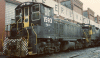
Hi Kali, I've never worked on a U-Boat or Dash 7, so I don't know very much about those engines, but I can tell you GE Dash 8's, Dash 9's and EVO's do not transition, that is a EMD thing. On older EMD's like the SD40 and SD40-2 line, they performed motor transition, meaning the traction motor circuits were setup in series, then at 22 to 25 mph the "series" contactors would drop out and the "parallel" contactors would pickup. On newer EMD's, SD50's, SD60's and SD70 series locomotives you now do Main Generator transition. Within the main generator package, you have two separate fields and stators. When the locomotive starts out, these two separate generators are in parallel (Just the opposite of how it use to be with the traction motors) then when you reach 22 to 25 mph, the main generator does transition and both halves are then in series.

I think I understand the point you are trying to make now about the diesel engines RPM's. The numbers AL is quoting is from their C44's and are different than our ES40DC's Here are the ES40DC RPM values which are also within a few RPM's of the Dash 9 values:

LOW IDLE 300
HIGH IDLE 44O
NOTCH 1 440
NOTCH 2 580
NOTCH 3 888
NOTCH 4 888
NOTCH 5 995
NOTCH 6 995
NOTCH 7 995
NOTCH 8 1050

Why are 3 & 4 the same and 5, 6 & 7 the same? Like you mentioned before, Tier II air pollutions standards and we can now use electronics to control the output of the Main Alternator. So yes I guess it would see that the jump from notch 2 to notch 3 would be raising the engine to a higher RPM than in previous years.

Yes thyristors are part of the EMD Chopper or the GE AAC (Aux Alternator Field Controller) but we actually use Inverters to control the AC traction motors. On a locomotive with AC traction motors, the Main Alternator produces AC voltage, that is rectified to DC voltage. We then use a Inverter to convert the DC voltage back to AC voltage for use with the traction motors as the only way to control the speed of a AC motor is to vary it's AC voltage frequency.

This is all neat stuff, but I'm afraid we maybe getting a little too technical on some aspects of the sim, but I do agree if it is possible to model the actual diesel engines RPM's and power output that would also be a step in the correct direction !!*ok*!!

Regards,
Rich S.
Cheers,
Rich S.
User avatar
Rich_S
 
Posts: 708
Joined: Tue Aug 24, 2010 11:19 pm
Location: Baden, PA, USA

Re: Another Piece of the puzzle....

Unread postby Kali » Fri Aug 10, 2012 8:40 am

I think ( now I need to go and read up again, dern my terrible memory ) that GE fitted a big enough generator to the U25 that it shouldn't have needed a transition, so I don't know why they ended up with one. Got some opinion from former drivers who roundly despised the things, who were saying that at transition the load controller totally reset ( which of course drops all the engine load and the turbo spins down even if the engine doesn't ) so then it'd have to go through the whole turbo spooling up process again - meanwhile of course your train is attempting to drag you back down the hill! at least it didn't have to spin the entire engine up...

Our 66s do the alternator transition; start with each half powering their own set of motors, & combine the two in series at some point, and I think they have a one field shunt but I can't really remember. I don't know what EMD guts they're based on, they're about as old as fuel injected SD70s so I guess they use roughly the same gear; the cab has a US style control stand ( backwards! ) rather than a UK desk cab like the 59s. Let's quietly forget the RW one's physics...

Transitions probably are worth modelling if they affect performance ( like the uboats! ) - using the built in RW mechanism for field shunts is not the way to go unless you're doing an electric though because it doesn't take generator voltage into consideration, so it's more realistic *not* to use it. The load controller is also worth poking around at when it does noticeable things, like old EMDs and their passenger settings where they try and keep everything smooth which just seems to end up as "slow to do anything", or GP7s and whatever that switch was that started the load controller at full travel - that must have been fun to switch with if you didn't have a neck brace. Details of how AC electrical systems work, not something to worry about no :)

I'm slowly trying to build a set of generic scripts to handle the more sophisticated stuff we want which the game obviously isn't, but that's a big project and bill paying tends to get in the way of that...
Kali
 
Posts: 1600
Joined: Mon Mar 14, 2011 1:00 am
Location: England-by-Sea

Re: Another Piece of the puzzle....

Unread postby Rich_S » Sat Aug 11, 2012 7:40 am

Kali wrote:I think ( now I need to go and read up again, dern my terrible memory ) that GE fitted a big enough generator to the U25 that it shouldn't have needed a transition, so I don't know why they ended up with one. Got some opinion from former drivers who roundly despised the things, who were saying that at transition the load controller totally reset ( which of course drops all the engine load and the turbo spins down even if the engine doesn't ) so then it'd have to go through the whole turbo spooling up process again - meanwhile of course your train is attempting to drag you back down the hill! at least it didn't have to spin the entire engine up...


Hi Kali,
I think you mean Load Regulator not load controller. The main purpose of the load regulator is to try and prevent the main alternator from bogging down the diesel engine by reducing it's field. I've never worked on any of the U-Boats, but I guess GE's used motor transition right up to the early Dash 7's, then switched to main alternator transition on the remainder of the Dash 7's. During transition, the diesel engine speed should remain constant and the field on the main alternator should be briefly removed, while the series contactors drop out and the parallel contactors pickup. Since I don't have any experience with the U-Boats or Dash 7's I don't understand why GE would have reduced the diesel engine speed on the U-Boats during transition? You are correct, GE now builds a strong enough main alternator that they do not need to worry about transition on the Dash 8's, Dash 9's and EVO's.

Regards,
Rich S.
Cheers,
Rich S.
User avatar
Rich_S
 
Posts: 708
Joined: Tue Aug 24, 2010 11:19 pm
Location: Baden, PA, USA

Re: Another Piece of the puzzle....

Unread postby Kali » Sat Aug 11, 2012 12:48 pm

They didn't reduce RPM, just load - but you unload a motor without doing anything else and it's going to try and speed up, so the governer drops the fuel flow to keep the RPM constant, exhaust pressure drops, turbo spools down, then you have to get the turbo spun up again while you're increasing generator excitation once more - especially given apparently the load regulator reset it's motion to the start, IE no excitation ... I'm informed it took a ridiculously long time. Seems an odd thing to do :shrug:

Sorry about that, we call 'em load controllers, they're doing the same job and I think they're built the same way; I don't think ours fed back in quite the same way as most of our diesels had infinitely variable throttles but I've never quite managed to decypher the feedback system, it looks like a pile of sphagetti.
Kali
 
Posts: 1600
Joined: Mon Mar 14, 2011 1:00 am
Location: England-by-Sea

Previous

Return to Rolling-Stock Design

Who is online

Users browsing this forum: No registered users and 10 guests