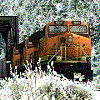
Anthracite:
I burn Antrancite in my Hitzer Coal/Wood stove. I order 2 or 3 tons, depending how cold I think it will get, for the season. I use a five gallon bucket every 12 hours and heats my house to upwards of 85 degrees. The Coal comes from Honesdale PA.
You know I always wondered 3 things. 1. What killed the EL and 2. Why does Scranton, PA look like a time capsule from 1949. 3. Why does the Hudson Generating track have leads to its coal pile yet no coal cars. What could be a contributing factor came last night while looking up info on 44 Tonners. As far as the Death of the EL is concerned we have the follwing issues:
1. Declineing Rail Traffic due to the Interstate Highway System and St. Lawrence Seaway
2. Property Taxes, particularly High Proptery Taxes in the NY Metropolitan area.
3. Taxation, high labor costs for industries/businesses in the North East
4. Weather damage to the rail network
5. The Knox Mine Disaster of 1959.
#5 is going to tie in to my questions and 2 components of my New York Division Bergen Line and my poll from last month. Remember "What route do you want to see next in TS2019"? All those Railroads go to Scranton Pa, excepting the LV, which went to Wikes-Barre. And why were all these railroads here? Coal. To be specific, it was Anthracite coal. Anthracite is hard, almost all carbon, and become popular for home heating, and was the reason why Pheobe Snow never had a smudge on her white attire.
Now for some dirty laundry: Monopoly, Anti-Trust, and Erie's ownership of the Pennslvania Coal Company. The PaCC operated mines around Pittson Pa, in Luzerne County. As cool production started to decline after the 1930s, the PaCC begain leasing the mines, Knox Mining was one of those companies.
Lets pause for some route tie-in: ( I am excerpting here from the following site
http://rails.jimgworld.com/stuff/s6.htmlNYS&W-RELATED OPERATIONS (Why I call Passaic Junction - Coalberg)
Another interesting Wyoming Division tidbit regards the isolated NYS&W mine branches off the Jessup Branch that stayed under NYS&W ownership until abandoned in the 1960's and 70's. The largest was the Winton Branch, about 4 miles, but there was also a spur to the Dolph Breaker near Jessup, and the Murray and Spencer breaker spurs in northeast Scranton. The NYS&W built these lines around 1890 as to begin mining operations upon lands it owned near Jessup, but depended upon connections to the Erie, D&H and O&W to access the traffic. Allegedly, the Susquehanna Connecting line constructed in the mid-1890s was meant to continue northeast after reaching Jermyn Breaker near Old Forge, as to squeeze in somehow amidst the DL&W, CNJ, NYO&W and D&H so as to reach the Winton Branch west of Jessup (Mohowski, NYS&W RR). This would unify the greater NYS&W network. However, as Erie influence grew after it leased the NYS&W in 1898, the final extension of the Susquehanna Connecting was scotched, and the isolated lines were integrated into the Erie's operations on the Jessup Branch.
However, the previous marketing and operating patterns remained. According to Mohowski, the Erie continued the established traffic patterns for customers of NYS&W-served breakers, many of whom were in the metro New York and New Jersey area. The Erie thus ran through trains via the Wyoming main to Lackawaxen, thence to Port Jervis and east to Coalberg Junction “BT” in Saddle Brook, NJ on the Bergen County Line. At BT (which was protected by an interlocking tower until closed in 1940), the trains crossed over to a connection with the NYS&W main east, for a 12 mile run to the Edgewater coal dumping facility along the Hudson River across from Manhattan. The NYS&W built this facility in the late 1890s and kept it in operation until 1948, when hard coal traffic for home heating was dying off. During the warm months, loaded hoppers would also be set out at Coalberg Jct., which was the site of a 400,000 ton capacity storage pile system.
Until its closure in 1946, coal would be unloaded and stored at Coalberg as to be reloaded into hoppers for final delivery during the winter peak heating demand (the facility had its own 0-6-0 switcher lettered “Coalberg Storage”, photo in the Mohowski NYS&W RR book). Prior to the mid-1930s, some Wyoming Division coal loads also went to the Pennsylvania Coal Company's Hudson River dumper at the end of Erie's Newburgh, NY branch (again, Pennsylvania Coal was retained by the Erie right up to the 1960 EL merger, unlike other eastern railroad coal subsidiaries that were divested by federal antitrust mandates in the 1910-1920 era).
ERIE'S PENNSYLVANNIA COAL COMPANY CARRIED THE CASH STRAPPED EL
As such, further research is needed regarding the operational relationship between Pennsylvania Coal Company and the Erie and Erie Lackawanna Railroads after the 2nd World War, after PaCC got out of the coal mining business. In an oversimplified nutshell, the Erie obtained ownership of PaCC in 1901, and there is evidence that PaCC remained largely self-sufficient and operationally independent for several decades (one small example regards the 0-6-0 switcher used at the PaCC coal piles at Coalberg in Saddle Brook, NJ; it was built in 1909 for the DL&W and later bought by PaCC and lettered "Coalberg Storage", despite the fact that both the Erie and NYS&W served this location and could have performed the necessary switching). It mined coal and harvested lumber from a large number of properties, and processed and marketed these products itself. However, beginning in the 1920s it began contracting with independent (mostly non-union) mining operators for production on its properties, albeit for marketing and distribution by PaCC. In 1930 it leased 7 major colliery operations to the Pittston Company as part of Van Sweringen control of the Erie (see M.J. Connor article "Erie Lackawanna Genealogy Part 2nd" in Vol. 24 No. 2). This was part of an arrangement by the Van Sweringens' Alleghany Company in attempting to get around antitrust law business limitations on railroad mining affiliates. Pittston reorganized following the Van Swerigen collapse in the mid 1930s and focused on bituminous mining in southern states, while Pennsylvania Coal continued to lease out its coal rights and facilities. For example, it initiated its first lease with the Knox Company (the mining lessee involved in the Riverside disaster of 1959) in 1943.
Even as the Depression ended and WW2 stimulated industrial activity, the prospects for anthracite mining production and demand declined rapidly in the Wyoming Valley. Pennsylvania Coal thus completely exited the business of marketing and shipping coal and allowed its contract operators to sell and distribute whatever they produced. It became a real estate management company, and according to Mr. Guthrie (see EL List, Nov. 21, 2009), provided net income into the 1970s. Mr. Guthrie refers to PaCC as the Erie and EL's "piggybank" (see EL List June 16, 2012 and April 10, 2008), and cites the fact that the EL borrowed funds from PaCC on a short term basis to bolster its weakening cash situation in the early 1960s (EL List, June 16).
According to statistics in Moodys Transportation Manual, the Erie and Erie Lackawanna Railroad carried Pennsylvania Coal on its asset ledgers at a book value of $5,100,000, from the early 1950s through 1968. After the Dereco takeover when the ELRR was reorganized at the Erie Lackawanna Railway, PaCC's book value was listed at $1,800,000. Neither Erie nor early EL management reported dividend payments from PaCC from the mid-50's thru 1966, despite the deep losses from rail operations experienced during most of these years. Then, from 1967 through 1972, the EL received a total of $4,310,000 in dividend distributions from PaCC. These were mostly the years of EL control by N&W/Dereco; they were also when the EL's long-term debt maturities increased from $10 to $15 million per year to $60 to $80 million. Obviously, the PaCC "piggybank" was being used by the EL to help ride out its "debt tsunami". During 1973-1976, when debt payoff was suspended because of bankruptcy, no further dividends were received from Pennsylvania Coal. The bankruptcy judge was possibly protecting whatever "family jewelry" was left for sake of eventual creditor settlement.
KNOX MINE DISASTER JANUARY 22ND 1959 (60 years ago in 8 days)
Link:
https://www.dailykos.com/stories/2012/2 ... al-CountryOn January 22, 1959, a hole broke open in the bed of the Susquehanna River near Pittston, PA – actually at Port Griffith. To the miners below it was imminent danger; to the industry that had been “King” it was another large step toward the end. Twelve men would perish, 69 would survive, while 33 of those would be amazingly, incredibly, heroically rescued; saved for their families and the future. The mine was called ‘River Slope’, it was owned by Knox Coal Co. Much would be learned following this disaster, much would be found that contributed to the tragedy.
That January 22nd morning had seen the river levels rise amid a customary “January Thaw”. Ice floes were moving along a swollen river and all seemed normal to the world. Suddenly a hole broke open in the ceiling of the River Slope Mine shaft. Water began pouring in, opening a growing hole in the riverbed. Icy, cold, cold water. Miners heard the thunder, and knew instantly, instinctively that something had gone wrong. Utterly, horribly, irreparably wrong. For those who would get out, life would never be the same; for the others, life would no longer be. Water seeks its own level.
Meanwhile in River Slope on January 22nd, an estimated 2.7 million gallons of water per minute poured into that mine shaft and other nearby, connected, and adjacent shafts. Ice blocks described by some survivors as being nearly the size of cars were finding their way into the tunnels. Men scurried, seeking safety and a travel route to the surface. Three of the six men working directly in the River Slope shaft fled to safety. Thirty three more workers from adjacent shafts caught the last elevators to the surface. Forty five men remained to find safety, escape, or death. A huge whirlpool, a swirling vortex had formed along the river’s edge, as water poured into the mine shafts below.
Knox Coal Co had leased the River Slope Mine from the Pennsylvania Coal Co, along with other mining rights in the Pittston/Port Griffith/Wyoming Valley area. State mining regulations called for a suggested thirty foot “buffer” of ground to remain between the river and any mine shaft. Knox had mined River Slope to within twenty inches. When warm temperatures and thawing, melting conditions swelled the Susquehanna on that fateful day, there was no stopping it. No turning back. The men that remained below ground (with a chance of escape) got separated into two groups. One group of 7 men included a surveyor who had maps and was familiar with a route to an abandoned shaft that would provide passage to the surface.
Upon reaching the abandoned shaft (now cluttered, if not filled, with debris), they began digging and removing debris on their journey upward. Thirty feet up they broke into an open shaft, but found the walls nearly straight up and nobody could hear their calls for help. Eventually one man, Amedeo Pancotti, volunteered to attempt the climb of another 50 feet of near vertical wall. Slowly and in adverse conditions, Pancotti reached the top, was found by rescuers on the surface.The passageway provided the means for the rescue of the last of those who would survive this disaster. Eighty one men had gone to work that morning, now less than a regular work shift later 69 had escaped. Heroes had risen to the call. conditions below ground worsened, and hopes for survival of the missing dwindled.
Meanwhile in Pittston and Port Griffith, at River Slope Mine, the community had gathered. It was known by all which 12 men remained beneath ground. The visible sight of the river pouring into the mine shafts was horriifying. Rescue efforts were being implemented as fast as possible. Efforts were made to fill the hole, stop the swirling vortex. Dirt and fill were dumped in, at one point, railroad cars were pushed in, anything to fill the space that was allowing the water to flow in. On January 13, five deep-sea divers arrived to aid in the search and rescue efforts. Pumping efforts didn’t start until January 26, but continued through July 24, long after it was accepted that those 12 brave souls were lost forever.
VIDEO HERE:
https://youtu.be/0D0KRmkT4P0The image of coal cars being pushed into the Susquehanna River to plug a 150 diameter hole is simply stunning.
THE END OF THE LACKAWANNA: (Wikipedia)
Perhaps the most catastrophic blow to the Lackawanna, however, was dealt by Mother Nature. In August 1955, flooding from Hurricane Diane devastated the Pocono Mountains region, killing 80 people. Hurricane Diane also caused the DL&W to abandon their Old Road/former Warren Railroad line due to severe damages that simply wouldn't be worth it to repair. The floods cut the Lackawanna Railroad in 88 places, destroying 60 miles (97 km) of track, stranding several trains (with a number of passengers aboard), and shutting down the railroad for nearly a month (with temporary speed restrictions prevailing on the damaged sections of railroad for months), causing a total of $8.1 million in damages (equal to $71,672,422 today) and lost revenue. Until the mainline in Pennsylvania reopened, all trains were cancelled or rerouted over other railroads. The Lackawanna would never fully recover.[1]
In January, 1959, the final nail in the Lackawanna's coffin was driven home when the Knox Mine Disaster flooded the mines along the Susquehanna River and all but obliterated what was left of the region's anthracite industry.
In conclusion, all the factors led to the demise of Lackawanna and then then the Erie-Lackawanna with the additional damage from Hurricane Agnes in 1972. The Knox Mine disaster, while not the primary cause, becomes the pivot point that begins the end. And with the loss of 5000 jobs in the Scranton Area in 1959, explains why in 1978 it looked like an empty city to this writer, when he saw the place for the first time. Last I think this partially explains why I see coal cars at the Hudson Generating Station in 1955 but not 1965. I do not remember seeing coal unit trains in 1972 on the EL.
There is just too much history here. I hope you enjoyed the long read as much as I did putting it together.

 by Spin » Sun Jan 13, 2019 10:27 am


 ( Just like Port Jervis).