
New electric locomotive.
https://www.trains.com/trn/news-reviews ... 430_000000
More: https://www.wabteccorp.com/locomotive
More: https://www.wabteccorp.com/locomotive/a ... s/flxdrive
Wabtech FLX Locomotive BEL44C4D #3000
Wabtech FLX Locomotive BEL44C4D #3000
 by AmericanSteam » Fri Apr 30, 2021 12:35 pm
Just an old Alaska guy trying to live in an insane world. Degree in life, Masters in common sense.
-

AmericanSteam - Posts: 2958
- Joined: Mon Nov 02, 2015 9:54 am
- Location: Nikiski, Alaska
Re: Wabtech FLX Locomotive BEL44C4D #3000
by HighBypass » Sat May 01, 2021 4:02 am
Interesting! I was initially confused by this statement:
There is no prime mover install so surely emissions should be zero?
Then I read the locomotive is designed to operate in a Hybrid consist - the penny dropped!
Emissions Reduces the train’s emissions by at least 10 percent.
There is no prime mover install so surely emissions should be zero?
Then I read the locomotive is designed to operate in a Hybrid consist - the penny dropped!
- HighBypass
- Posts: 98
- Joined: Thu Mar 25, 2021 3:48 pm
Re: Wabtech FLX Locomotive BEL44C4D #3000
by AmericanSteam » Sat May 01, 2021 8:54 am
It's only brought on to power when needed and recharges during braking using the traction motors like an electric vehicle.
Just an old Alaska guy trying to live in an insane world. Degree in life, Masters in common sense.
-
AmericanSteam - Posts: 2958
- Joined: Mon Nov 02, 2015 9:54 am
- Location: Nikiski, Alaska
Re: Wabtech FLX Locomotive BEL44C4D #3000
by buzz456 » Sat May 01, 2021 9:42 am
Another silly feel good idea for the eco nuts. How much resources did it take to make this monster?
Buzz
39 and holding.
"Some people find fault like there's a reward for it."- Zig Ziglar
"If you can dream it you can do it."- Walt Disney

39 and holding.
"Some people find fault like there's a reward for it."- Zig Ziglar
"If you can dream it you can do it."- Walt Disney
-

buzz456 - Site Admin
- Posts: 21388
- Joined: Sun Mar 21, 2010 8:30 am
- Location: SW Florida
Re: Wabtech FLX Locomotive BEL44C4D #3000
by AmericanSteam » Sat May 01, 2021 11:18 am
The money came from a grant from California resources board, where else, in cooperation with BNSF, as to all the batteries ask the energizer bunny. Just think of it as a very large Tesla.
Just an old Alaska guy trying to live in an insane world. Degree in life, Masters in common sense.
-
AmericanSteam - Posts: 2958
- Joined: Mon Nov 02, 2015 9:54 am
- Location: Nikiski, Alaska
Re: Wabtech FLX Locomotive BEL44C4D #3000
by EngineerJohn » Mon May 03, 2021 3:22 pm
The battery box better be made out of tank armor, and like Buzz alluded to, you need a lot of resources to make these things happen and involves very nasty chemicals you don't want anywhere near yourself.
https://www.nytimes.com/2021/04/18/busi ... texas.html
Some of you may recall this Tesla car fire. It did take fire crews 4 hours to put it out, with enough water to fill a good sized pool.
Scale that up to a locomotive. If one derails and catches fire it's an environmental disaster and then some.
I'm all for new tech. Tesla does amazing work. But these things are giant unstable fireballs waiting to happen, orders of magnitude worse than gas and diesel. We don't quite have good ways to suppress them yet to my knowledge.
https://www.nytimes.com/2021/04/18/busi ... texas.html
Some of you may recall this Tesla car fire. It did take fire crews 4 hours to put it out, with enough water to fill a good sized pool.
Scale that up to a locomotive. If one derails and catches fire it's an environmental disaster and then some.
I'm all for new tech. Tesla does amazing work. But these things are giant unstable fireballs waiting to happen, orders of magnitude worse than gas and diesel. We don't quite have good ways to suppress them yet to my knowledge.
“A designer must always think about the unfortunate production engineer who will have to manufacture what you have designed; try to understand his problems.” - Raymond Loewy
-

EngineerJohn - Posts: 374
- Joined: Wed Oct 17, 2018 5:56 am
- Location: New York
Re: Wabtech FLX Locomotive BEL44C4D #3000
by AmericanSteam » Mon May 03, 2021 7:53 pm
As in any new technology, things go wrong and sometimes horribly. All new technology is always on a learning curve. I was working for a Chevrolet dealership when everything was carburetors with the exception of Corvettes with the Fuel Injection package. I have seen the changes to direct injection, variable valve timing, small displacement turbocharged engines, hybrid cars and trucks, 10 and 12 speed transmissions, all electric medium trucks and mainstream truck and automobile diesels. Usually everything improves. You can do so much in a controlled environment or lab setting. Everything eventually gets field tested.This is where all the weird faults appear with time and miles on the road and how people abuse them. I will say this, if there is a way to abuse anything people will find a way. I have seen this time again. People will destroy a highly technical vehicle in a heartbeat if given their own resources. The EV industry is developing training standards for emergency personnel. The technology is so much improved and improving even more.
Just an old Alaska guy trying to live in an insane world. Degree in life, Masters in common sense.
-
AmericanSteam - Posts: 2958
- Joined: Mon Nov 02, 2015 9:54 am
- Location: Nikiski, Alaska
Re: Wabtech FLX Locomotive BEL44C4D #3000
by AmericanSteam » Mon May 03, 2021 8:08 pm
buzz456 wrote:Another silly feel good idea for the eco nuts. How much resources did it take to make this monster?
The big advantage is fuel savings. In this day in age where we have sacrificed fuel independence for "green house gas emissions" fuel costs are a big uncertainty. This is the hedge for that and also to be competitive with the trucking industry. One must remember the trucking industry is considering electric driver-less trucks as well. Railroads must be competitive to survive. The latest information I could find was for 2009 where 3.192 billion gallons were used for freight traffic. https://wasteadvantagemag.com/fuel-in-t ... -industry/
Last edited by AmericanSteam on Tue May 04, 2021 10:09 am, edited 1 time in total.
Just an old Alaska guy trying to live in an insane world. Degree in life, Masters in common sense.
-
AmericanSteam - Posts: 2958
- Joined: Mon Nov 02, 2015 9:54 am
- Location: Nikiski, Alaska
Re: Wabtech FLX Locomotive BEL44C4D #3000
by HighBypass » Tue May 04, 2021 8:15 am
AmericanSteam wrote:Railroads must be competitive to survive.
Are they not already, considering the amount of semi trailers (one shipping container = 1 semi) a freight train can haul?
- HighBypass
- Posts: 98
- Joined: Thu Mar 25, 2021 3:48 pm
Re: Wabtech FLX Locomotive BEL44C4D #3000
by _o_OOOO_oo-Kanawha » Tue May 04, 2021 10:10 am
AmericanSteam wrote:The EV industry is developing training standards for emergency personnel. The technology is so much improved and improving even more.
Battery fires in e-cars are already considered very dangerous. What about this locomotive with 100 or more tons of battery aboard? Don't know what the running voltage is, but I suppose at least 600V and with a current capacity of several thousand Amperes, any electrical fire is virtually inextinguishable, and that is before the various metalo-organic chemical compounds catch fire.
Last edited by _o_OOOO_oo-Kanawha on Tue May 04, 2021 2:32 pm, edited 1 time in total.
Edwin "Kanawha"

The Chessie, the train that never was ... (6000 hp Baldwin-Westinghouse steam turbine electric)
The Chessie, the train that never was ... (6000 hp Baldwin-Westinghouse steam turbine electric)
-

_o_OOOO_oo-Kanawha - Posts: 3231
- Joined: Mon Nov 14, 2011 2:12 pm
Re: Wabtech FLX Locomotive BEL44C4D #3000
by AmericanSteam » Tue May 04, 2021 10:52 am
This push towards a quick fix for a either a perceived or real climate crises may lead us down a road of a too quick acceptance of new technology. Science and industry have always used the rational that all advances in technology have its costs and in reality this is correct. We have become better at it with computer modeling but we still get back to the "it looked good on paper" excuse when things go wrong. Time in service is where reality meets with theory.
Ton-miles of freight is cheaper by train but total shipping time has become the issue. Precision scheduling has helped immensely. Railroads are thinking in terms of competition with the trucking industry rather than thinking they would automatically retain the shipping business. Containerized shipping has been the best thing in the last 20 years for railroad. No doubt that the whole shipping industry is going through major changes. The biggest consideration will on be on First and last mile service. Many railroads are leasing trackage to shortline railroads to help facilitate this. A win win situation. The shortline deals directly with the customer and can adapt quickly to their needs and the big railroad gets the freight business and does what it does best.
I have a subscription to Trains Magazine and enjoy the articles on the industry.
Ton-miles of freight is cheaper by train but total shipping time has become the issue. Precision scheduling has helped immensely. Railroads are thinking in terms of competition with the trucking industry rather than thinking they would automatically retain the shipping business. Containerized shipping has been the best thing in the last 20 years for railroad. No doubt that the whole shipping industry is going through major changes. The biggest consideration will on be on First and last mile service. Many railroads are leasing trackage to shortline railroads to help facilitate this. A win win situation. The shortline deals directly with the customer and can adapt quickly to their needs and the big railroad gets the freight business and does what it does best.
I have a subscription to Trains Magazine and enjoy the articles on the industry.
Just an old Alaska guy trying to live in an insane world. Degree in life, Masters in common sense.
-
AmericanSteam - Posts: 2958
- Joined: Mon Nov 02, 2015 9:54 am
- Location: Nikiski, Alaska
Re: Wabtech FLX Locomotive BEL44C4D #3000
by GSkid » Thu May 06, 2021 2:05 am
Testing began in California at the start of this year from Stockton to Barstow and ended in April as far as I know. The terrain consists of flat running through the agricultural valley from Stockton to Bakersfield, the steep mountain grade over Tehachapi Pass to Mojave and flat desert running to Barstow. I'm guessing they purposely chose the cooler part of the year to test. Both the valley and the desert average 90s and higher in the summer.
It's their performance at very low and very high ambient temperatures I'm really curious about. Lithium batteries lose capacity as they get colder. So a battery that has 100% capacity at a temp of 75°F, will go down to only 25%-30% capacity once you get close to 32°F and lower. At the higher temps, you have to worry about overheating. Not only will it shorten the overall lifespan of the battery, but it could also make them explode.
This locomotive almost certainly has battery cooling fans to keep the temps down in warm climates. I wonder if they have heating elements to keep battery temps up in colder climates so their capacity doesn't go down.
I own a Goal Zero Yeti 3000 solar generator with a 3,075 Watt-Hour Lithium-ion NMC battery. It has safety monitoring and cooling fans. It doesn't allow charging if the battery hits 32°F on the low end and 113°F on the high end. It also stops me being able to draw power from the battery at temps -4°F and 149°F respectively.
In the solar generator world (excluding deep cycle lead-acid based systems) there are two main lithium battery types.... Lithium NMC (Nickel-Manganese-Cobalt Oxide).... and LiFePO4 or LFP battery (Lithium Iron Phosphate).
NMC's main advantages over LFP are a higher power density and typically cheaper upfront cost than an LFP battery of the same watt-hour capacity. So an LFP battery of the same exact physical size as an NMC battery, will pack less watt-hours of battery capacity.
NMC's main disadvantages are that it's batteries are more prone to exploding if the battery ever overheats (NMC Thermal runaway 210°C (410°F). High charge promotes thermal runaway. .... Vs..... LFP Thermal runaway 270°C (518°F) Very safe battery even if fully charged) ... or is punctured by a hard object. LFP batteries are far less susceptible in both of those attributes.
While my Goal Zero's NMC battery is rated for 500 cycles to reach 80% of it's original capacity, an LFP can get 3-5 times that amount of cycles. That also depends on battery temps and what your charge/discharge range is. Also.... LFP has a little bit longer charge shelf life. Tesla is slowly moving to LFP batteries. Goal Zero currently doesn't offer a LFP battery option or upgrade. I'm not even for sure if my current charge controller is compatible with an LFP battery even if they were to offer such an option in the future.
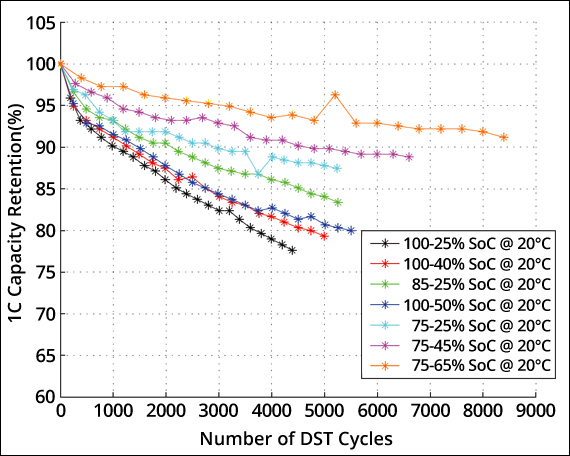
The chart from battery university in the link below shows keeping a battery charge/discharge range of 65%-75% capacity gives your battery the longest overall lifespan.... with a 45%-75% being the 2nd best range..... 25%-75% being the 3rd best ..... and progressively worse as the chart shows for other ranges.
https://batteryuniversity.com/_img/cont ... s-web2.jpg
I keep mine in the 65%-75% range the majority of the time, but I will go as low as 45% if I need to draw from it for an extended time. I've had it over 3 years and it's still going strong.
It's their performance at very low and very high ambient temperatures I'm really curious about. Lithium batteries lose capacity as they get colder. So a battery that has 100% capacity at a temp of 75°F, will go down to only 25%-30% capacity once you get close to 32°F and lower. At the higher temps, you have to worry about overheating. Not only will it shorten the overall lifespan of the battery, but it could also make them explode.
This locomotive almost certainly has battery cooling fans to keep the temps down in warm climates. I wonder if they have heating elements to keep battery temps up in colder climates so their capacity doesn't go down.
I own a Goal Zero Yeti 3000 solar generator with a 3,075 Watt-Hour Lithium-ion NMC battery. It has safety monitoring and cooling fans. It doesn't allow charging if the battery hits 32°F on the low end and 113°F on the high end. It also stops me being able to draw power from the battery at temps -4°F and 149°F respectively.
In the solar generator world (excluding deep cycle lead-acid based systems) there are two main lithium battery types.... Lithium NMC (Nickel-Manganese-Cobalt Oxide).... and LiFePO4 or LFP battery (Lithium Iron Phosphate).
NMC's main advantages over LFP are a higher power density and typically cheaper upfront cost than an LFP battery of the same watt-hour capacity. So an LFP battery of the same exact physical size as an NMC battery, will pack less watt-hours of battery capacity.
NMC's main disadvantages are that it's batteries are more prone to exploding if the battery ever overheats (NMC Thermal runaway 210°C (410°F). High charge promotes thermal runaway. .... Vs..... LFP Thermal runaway 270°C (518°F) Very safe battery even if fully charged) ... or is punctured by a hard object. LFP batteries are far less susceptible in both of those attributes.
While my Goal Zero's NMC battery is rated for 500 cycles to reach 80% of it's original capacity, an LFP can get 3-5 times that amount of cycles. That also depends on battery temps and what your charge/discharge range is. Also.... LFP has a little bit longer charge shelf life. Tesla is slowly moving to LFP batteries. Goal Zero currently doesn't offer a LFP battery option or upgrade. I'm not even for sure if my current charge controller is compatible with an LFP battery even if they were to offer such an option in the future.
The chart from battery university in the link below shows keeping a battery charge/discharge range of 65%-75% capacity gives your battery the longest overall lifespan.... with a 45%-75% being the 2nd best range..... 25%-75% being the 3rd best ..... and progressively worse as the chart shows for other ranges.
https://batteryuniversity.com/_img/cont ... s-web2.jpg
I keep mine in the 65%-75% range the majority of the time, but I will go as low as 45% if I need to draw from it for an extended time. I've had it over 3 years and it's still going strong.
EMD 2-strokes rule! My all time favorite: SD45X also love the SD40-2/SD40T-2/SD45-2/SD45T-2/DD35A/DDA40X/SD70ACe/SD80ACe
Southern Pacific RR! Bloody nose/Serif lettering - Donner Pass/Tehachapi Pass/Cajon Pass/UP Coast Line
i7-11800H // RTX 3070 // 16GB DDR4 // 2TB SSD // 16” 165Hz WQXGA 16:10 w/G-Sync // TS Classic // TSW5 // Run 8 V3
Southern Pacific RR! Bloody nose/Serif lettering - Donner Pass/Tehachapi Pass/Cajon Pass/UP Coast Line
i7-11800H // RTX 3070 // 16GB DDR4 // 2TB SSD // 16” 165Hz WQXGA 16:10 w/G-Sync // TS Classic // TSW5 // Run 8 V3
-

GSkid - Posts: 1197
- Joined: Fri Sep 07, 2012 2:17 am
- Location: UP's Santa Barbara subdivision - USA
Re: Wabtech FLX Locomotive BEL44C4D #3000
by BNSFdude » Thu May 06, 2021 5:48 am
If you look into the locomotive on Wabtecs site, they mention a full HVAC suite to keep the batteries conditioned properly. My curiousity is in how many KWh the HVAC system needs in the extremes to do so.
Anthony Wood
Audio Engineer - Searchlight Simulations
Audio Engineer - Searchlight Simulations
-

BNSFdude - Posts: 2721
- Joined: Tue Nov 29, 2011 1:46 am
Re: Wabtech FLX Locomotive BEL44C4D #3000
by AmericanSteam » Fri May 07, 2021 11:57 am
More from Union Pacific on electric locomotives. https://www.trains.com/trn/union-pacifi ... 507_000000
Still no comments on the added usage to the electrical grid. Again the question, what happens when the power goes out?
Still no comments on the added usage to the electrical grid. Again the question, what happens when the power goes out?
Just an old Alaska guy trying to live in an insane world. Degree in life, Masters in common sense.
-
AmericanSteam - Posts: 2958
- Joined: Mon Nov 02, 2015 9:54 am
- Location: Nikiski, Alaska
Re: Wabtech FLX Locomotive BEL44C4D #3000
by BNSFdude » Fri May 07, 2021 12:01 pm
AmericanSteam wrote:More from Union Pacific on electric locomotives. https://www.trains.com/trn/union-pacifi ... 507_000000
Still no comments on the added usage to the electrical grid. Again the question, what happens when the power goes out?
What happens when you run out of fuel? That question is a non-starter. Railroads run locomotives dry more often than you think because their internal communications skills are less than elementary.
Anthony Wood
Audio Engineer - Searchlight Simulations
Audio Engineer - Searchlight Simulations
-
BNSFdude - Posts: 2721
- Joined: Tue Nov 29, 2011 1:46 am
50 posts
• Page 1 of 4 • 1, 2, 3, 4
Who is online
Users browsing this forum: No registered users and 21 guests